Digital Passport

EXECUTIVE SUMMARY

Fixing our end-to-end technology delivery processes to decrease bail-out rates, minimize time-to-market, and resolve bottlenecks and frustrations from our internal teams.

85%

decrease in intake fields

67%

decrease in forms

60%

decrease in sign-offs

PROJECT OVERVIEW

Timeline: June 2024 - December 2025

Team: Product Owner, Engineering Lead, Customer Experience Lead, Committee Leads

  • Partnered with the CX team to map out the current experience

  • Worked with the Product Owner to create and visualize the simplified flows

  • Created wires and clickable prototypes to review with various team leads for validation

  • Created the final mocks for implementation by engineering

My Role:

THE PROBLEM/CHALLENGES

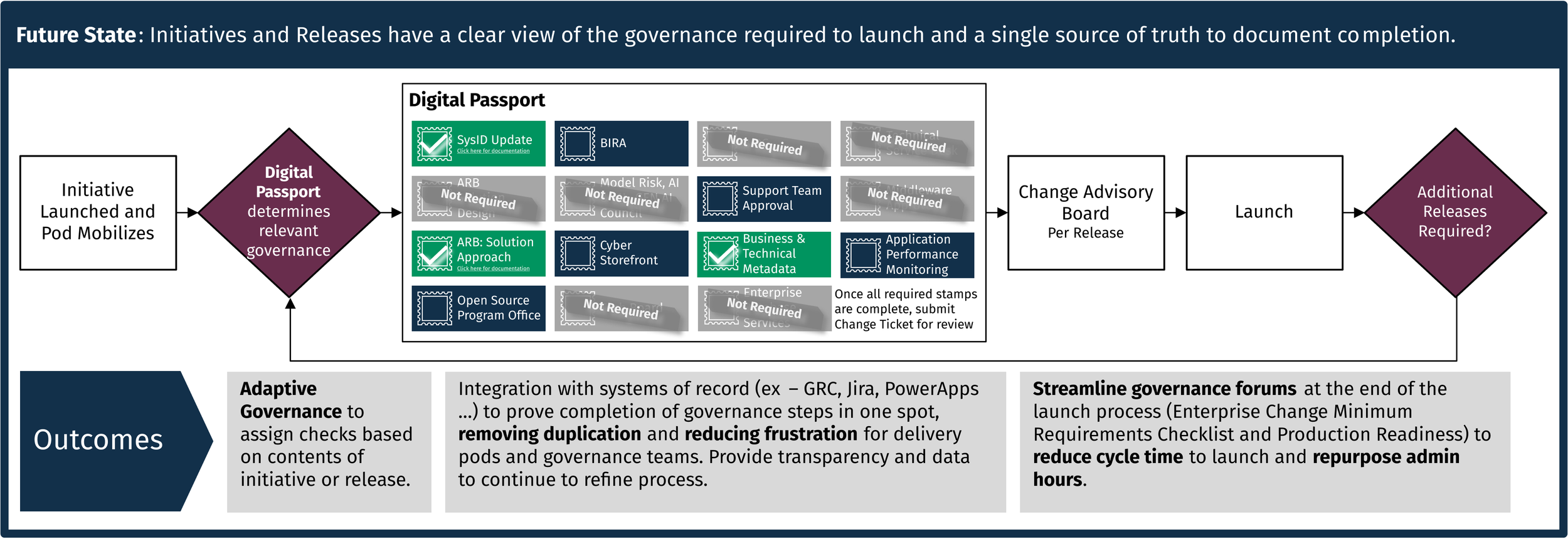
Investigate the root cause of problems within our operating model. Create a single source-of-truth for adaptive governance that provides clarity to team on what they need and when they need it - while minimizing and streamlining the processes necessary.

  • The new implementation had to work within our current system

  • Final design had to be as minimally invasive as possible

  • Process issues within the individual committees would not be addressed in Phase 1

CONSTRAINTS

THE METHOD

Investigating the root cause of the backlog, delay in time-to-market, and increase in the failure rate of post-MVP delivery, we found that the majority of users were running into challenges that made them quit the process, and, at times, put hiring on hold due to the limitations of the system.

Direct quotes from research:

  • We explain the solution over and over to every board, like when Zuckerberg testified to congress and explained the internet.”

  • “Pods are coming to us [governance groups] at the last minute because they miss steps, causing fire drills.”

  • You can't train folks on this process. I don't want to hire people off the street, because you can't buy the experience navigating Citizens.”

The drill down into our processes exposed that, to complete an initiative, it can take up to

  • 198 Intake Fields (150 avg.)

  • 12 Intake forms (7 avg.)

  • 16 Forums (10 avg.)

  • 107 Sign Offs (74 avg.)

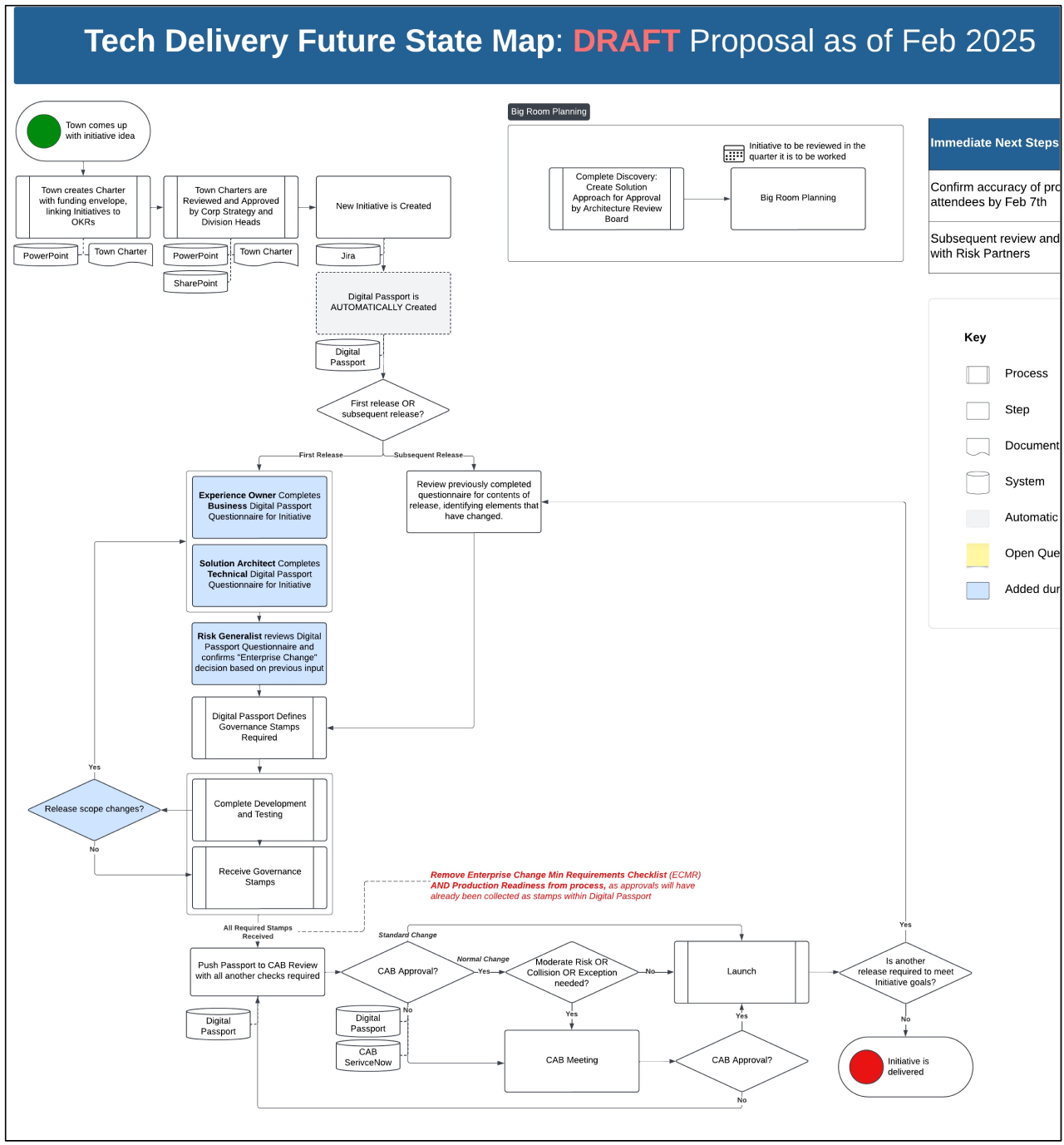
and, in order to navigate the process, users would need to refer to the following flow chart to explain the steps and bottlenecks

RESEARCH

PROCESS CLEANUP

Working with my CX team, and Engineering lead, we got into the details of the processes and recognized how many redundancies and extra steps were being forced upon our internal teams. We worked with each of the governance teams to understand which parts of the process were necessary and which were additional for certain use cases. From there I mapped out a simplified process with the teams, and my Engineering lead, helped document the simplification of the backend.
SKETCHING/WIREFRAMING

Working with my CX team, and Engineering lead, we got into the details of the processes and recognized how many redundancies and extra steps were being forced upon our internal teams. We worked with each of the governance teams to understand which parts of the process were necessary and which were additional for certain use cases. From there I mapped out a simplified process with the teams, and my Engineering lead, helped document the simplification of the backend.

THE SOULTION

Final version

THE FOLLOW-UP

Where are things now? What would I have done different.


Citizens Bank | Private Bank

Previous

EdX

Next

via201.png

Intralinks VIA®

BACKGROUND

Intralinks VIA was the new, web-based product from Intralinks, that allowed our clients to create large-scale content repositories and case management, along with document-centered workflows and content creation and editing.  

With the release of the VIA platform, there was very little attention paid to the mobile experience, until management began hearing back from customers that the need for access on phone and tablet would be a need for people in the field.

THE CHALLENGE

I was tasked to create the proof-of-concept (release 1) and general availability (release 2) design of both the Android and iOS applications.  Due to the fact that release 1 needed to be designed in a very short time frame of 3 weeks, I took the focus on the Android design and lead a team of new hires to build the design of the iOS application.

THE OUTCOME

VIA was the first mobile platform and the first of the redesign of the company priorities, which lead the push into various forms of secure file-sharing while on-the-go. It is the foundation of the rest of the applications that were built.

400+ million

documents uploaded

6.6+ million

users on the platform

64 thousand

downloads

PROOF OF CONCEPT

The Engineering and PM leads wrote generic user stories detailing the workflows that had been determined to be ported from web to mobile. 

I picked up the project from there, understanding the workflows that would be presented in a mobile experience, and ensuring the needs of our users would be met.  From these workflows, screens were built out leveraging the design style of the company and the details from the Android Developer design guidelines.

The team that was dedicated to building this was offsite, and the company had not yet created a design system, so a lot of the work had to be spec'd out screen by screen to ensure our team could build the screens correctly.

Each icon and image for the application had to be created as a one-off to scale (mdpi - xxhdpi) for the engineering team to integrate into the code base.

GENERAL AVAILABILITY RELEASE

The proof of concept work (release 1) proved successful enough that the product team was given the green light to build the GA release of the VIA application.  

Based on the feedback we received from our early adopters was that more of their users were accessing the documents on iPhones and iPads, so my focus was to design around that platform, but make the majority of the design OS agnostic.  Interactions (such as swiping left on iOS vs right on Android and how modals and errors were presented) would be where the design diverged.

I started by picking apart the workflows that were integrated in the first version of the application, and documenting both the current flows necessary as well as the flows that needed to be added.  It started by meeting with both the internal and external stakeholders to understand the needs.

After understanding the workflows and features that were deemed to be necessary from the interviews, I worked with my engineering leads, and wrote out the user stories for each of the scenarios.

Screen Shot 2018-03-06 at 5.08.27 PM.png

From the created stories, the necessary screens were listed out and I began by sketching out concepts with the other mobile designer to address the needs of each one.  These sketches were reviewed by the full product team and company leadership to tailor them down to a few concepts, and then they went through usability testing with a subset of our stakeholders.

A/B testing with internal and external stakeholders trimmed the designs down to best accepted and lead to the creation of low-res wireframes for each screen in the application.  These wires were built in Axure allowing for both screen design and interactions  to be built and tested with the same stakeholders that we tested the sketches with.

During the wireframe sessions, I hired a visual designer to help create the style and branding guidelines for our applications.  This allowed me to partner with him on some of the wireframes to get an understanding of what assets would need to be created and what patterns and colors we needed to address. 


FOLLOW-UP

The App has been available for secure file-sharing since 2014 and continues to follow the design standards I created for it through an acquisition by SS&C and updates to technology (from Jellybean [4.4] through to Cinnamon Bun [17]) .